Harper expected a lavish baby shower for 150 wealthy guests at a riverside estate. Her future in-laws expected sophistication. Brenda expected admiration.
What they were really going to receive was an empty room.
Forty-eight hours before the event, Harper burst into the kitchen with the phone in her hand.
“The designer found an Italian crib,” she announced. “And custom-made silk wallpaper. She needs a deposit. Transfer me ten thousand dollars.”
I continued cleaning the stainless steel.
“No.”
Harper blinked as if the word had hit her in the face.
“Pardon?”
“No,” I repeated. “I don’t have ten thousand dollars for wallpaper.”
“You have forty-two thousand there doing nothing.”
“He’s not doing nothing,” I replied. “He’s keeping me alive.”
She stamped her foot like an angry child.
“I’m having a baby.”
“Then ask the baby’s father.”
The kitchen doors opened.
Brenda came in wearing pearls and carrying a sheet of yellow legal pad paper. She placed it on the counter in front of me. Written in her cursive handwriting was a contract in which I agreed to transfer all my personal savings to Cook Catering’s operating account for “family needs and event expenses.”
Below was a blank line for my signature.
“What is this?” I asked.
“Your rent,” Brenda replied. “You live under our roof. You eat our food. Sign, or you can sleep on the street.”
A year earlier, she would have cried. She would have begged. She would have tried to explain that she had earned that money night after night without sleep.
But the betrayal had burned away all the gentleness that remained in me.
I took the paper, folded it carefully, and put it in my apron pocket.
“Give it back,” Brenda snapped.
“You wrote it for me,” I said calmly. “I think I’ll keep it.”
Richard then entered, red with anger and booming.
“You ungrateful little girl. You owe everything to this family.”
I looked at him closely. I really looked at him. His forehead was sweaty. His finger was trembling. The man who had spent my whole life making himself seem enormous, suddenly seemed very small.
“Let’s do the math, Richard,” I said.
His finger faltered.
“I worked eighty hours a week for three years. I handled inventory. I organized your accounting books. I cooked for events you sold but were unable to execute. At a normal salary for a chef and operations manager, you owe me approximately one hundred and fifty thousand dollars in unpaid wages.”
Harper gasped.
“You don’t own my savings,” I continued. “You don’t own my future. I’m not your bank account. I’m not your maid.”
The silence that followed was beautiful.
Then Brenda did what weak people always do when the truth corners them: she called me hysterical.
“He needs to be punished,” he told Richard.
A punishment.
He was twenty-six years old.
Richard grabbed my arm and dragged me upstairs to the storage room above the prep kitchen, a hot, dusty space filled with old tablecloths, broken equipment, and filing boxes. He locked the door from the outside.
**PART 4**
—“We’ll let you out when you’re ready to apologize,” she said.
His footsteps led away.
I was left alone in the heat, surrounded by years of hidden financial documentation.
Then I smiled.
They thought I had been locked up in prison.
Actually, they had locked me inside their vault.
I opened my laptop, connected to my phone’s hotspot, and logged into the state business registry portal. Marcus Vance had already prepared the dissolution documents. I uploaded the files, signed electronically, and scheduled the filing for 8:00 a.m. on Saturday.
Then I created an encrypted folder called **Exhibit A**.
Inside, I kept the forged operating agreement, the IRS notice of repossession, proof of loans taken out in my name, contracts with vendors, and Brenda’s handwritten extortion demand. I sent a copy to Valerie, another to Marcus, and another to myself.
Valerie responded with a single sentence.
“Now go out clean.”
And that’s what I did.
The next morning, Richard opened the storage room expecting tears. I walked past him without a word, went downstairs, tied on a clean apron, and mopped the already spotless floor.
Brenda watched me from the doorway.
“Silence treatment?” he asked.
I submerged the mop in water with bleach and kept moving.
She believed that silence was surrender.
Sometimes silence means the fuse is already lit.
—
**PART 4**
By Friday afternoon, the whole house was trembling under the weight of its own lies.
Harper found my suitcases hidden under a tarp in my closet. I heard her scream from the kitchen.
—Mom! She’s leaving! She’s packed her bags!
Richard stormed into his office and returned waving the fake itinerary I had put up.
“New York,” he announced triumphantly. “Three o’clock tomorrow afternoon. Terminal B.”
Brenda laughed, sharp and unpleasant.
—Did you think you could run away to New York and play chef?
I leaned on the preparation table.
—My flight is booked.
It was technically true. Only not the one they thought.
Richard positioned himself to block the exit. Brenda stood in front of the revolving doors. Harper stood behind them, agitated, her breathing rapid.
“You’re not leaving,” Richard said. “You belong to this family until we decide otherwise.”
Brenda picked up her phone.
—If you walk out that door, I’ll call the police and say you stole from the business.
I took a step towards her.
—Are you sure you want the police to review your finances, Brenda?
The use of her first name hit her like a slap in the face. In twenty-six years, she had never called her anything other than “Mom.” That word shattered in midair, ripping away the illusion. It wasn’t my mother standing in that kitchen. It was a desperate businesswoman, standing atop a mountain of fraud.
**PART 4 (continued / end of this section)**
His hand slowly descended.
“If the police come,” I said, “I’ll hand over the accounting books. I’ll let the detectives audit every account. Go ahead. Make the call.”
Brenda stepped away from the threshold.
The phone went silent.
That night, messages from relatives started arriving. Aunt Susan said my mother was crying. Uncle David accused me of destroying the family. A cousin claimed Harper thought I needed psychological intervention.
Brenda was building her public narrative. I was unstable. Cruel. Selfish. Unhinged.
I didn’t answer.
The IRS doesn’t care about family drama.
At four in the afternoon, I looked out of my bedroom window and saw Richard park his enormous SUV directly behind my car, trapping it between the brick wall of the kitchen and a ditch.
He looked towards my window with satisfaction.
I thought I had been locked in.
But I had never planned to drive.
At 1:45 a.m., I dressed in black, silently carried my suitcases down the hall, and descended the back stairs to the commercial kitchen. The house was quiet. My parents were asleep, convinced that the SUV had sealed my fate.
I turned on a single dim light above the extractor hood.
Before leaving, I cleaned my station one last time. I polished the stainless steel table until it reflected the light like a mirror. I opened the walk-in freezer and looked at the empty shelves. No lobster. No meat. No oysters. No future for Cook Catering.
Then I took off my stained white apron.
That apron had grease burns, wine stains, and three years of unpaid labor on it. I folded it carefully and placed it in the center of the prep table. Underneath, I laid Brenda’s yellow extortion contract.
Unsigned.
At the end of the road, Valerie was waiting for me in a dark sedan with the lights off.
The wheels of my luggage crunched on the gravel.
Halfway there, the automatic motion-activated lights suddenly came on. Richard darted out onto the porch in a bathrobe.
“Stop!” he roared. “I blocked your car!”
I kept walking.
“You’re not going anywhere!” he shouted.
Valerie opened the trunk. I put the suitcases in, got into the passenger seat, and closed the door.
She started driving without turning on the lights until she reached the county road.
“Did you leave the kitchen clean?” he asked.
-Flawless.
—And the cold storage room?
-Empty.
Valerie let out a low whistle.
—That party is going to turn into a public disaster.
“No,” I said quietly. “The disaster was having my passport stolen.”
At 8:00 am, while we were having breakfast in a quiet hotel near the airport, my phone exploded with notifications.
The dissolution of the company had been registered.
Cook Catering’s accounts were frozen. Suppliers were rejecting orders. Insurance policies had expired. Delivery drivers were demanding cash. Florists refused to set up without final payments. The event planner called Harper. Harper called Brenda. Brenda called Richard. Richard called me forty-three times.
I didn’t answer.
At ten o’clock, videos began appearing in family chats. Harper was at the riverside estate, fully made up, yelling in front of empty tables. Brenda was crying on the phone as guests arrived. Richard was arguing with a seafood vendor in the parking lot. One guest asked loudly, “Where’s the food?”
Valerie watched one of the videos and murmured:
—That’s brutal.
—No —I replied—. Stealing my passport was brutal.
We entered the airport at eleven o’clock.
My new passport was safe in my bag. The evidence was backed up in three places. My ticket was real. My money was safe.
For the first time in my life, I felt nervous for the right reason.
I was no longer afraid of my parents.
I was afraid of freedom.
In the security area, Valerie hugged me once, quickly and tightly.
“Don’t look back,” he said.
-I won’t do it.
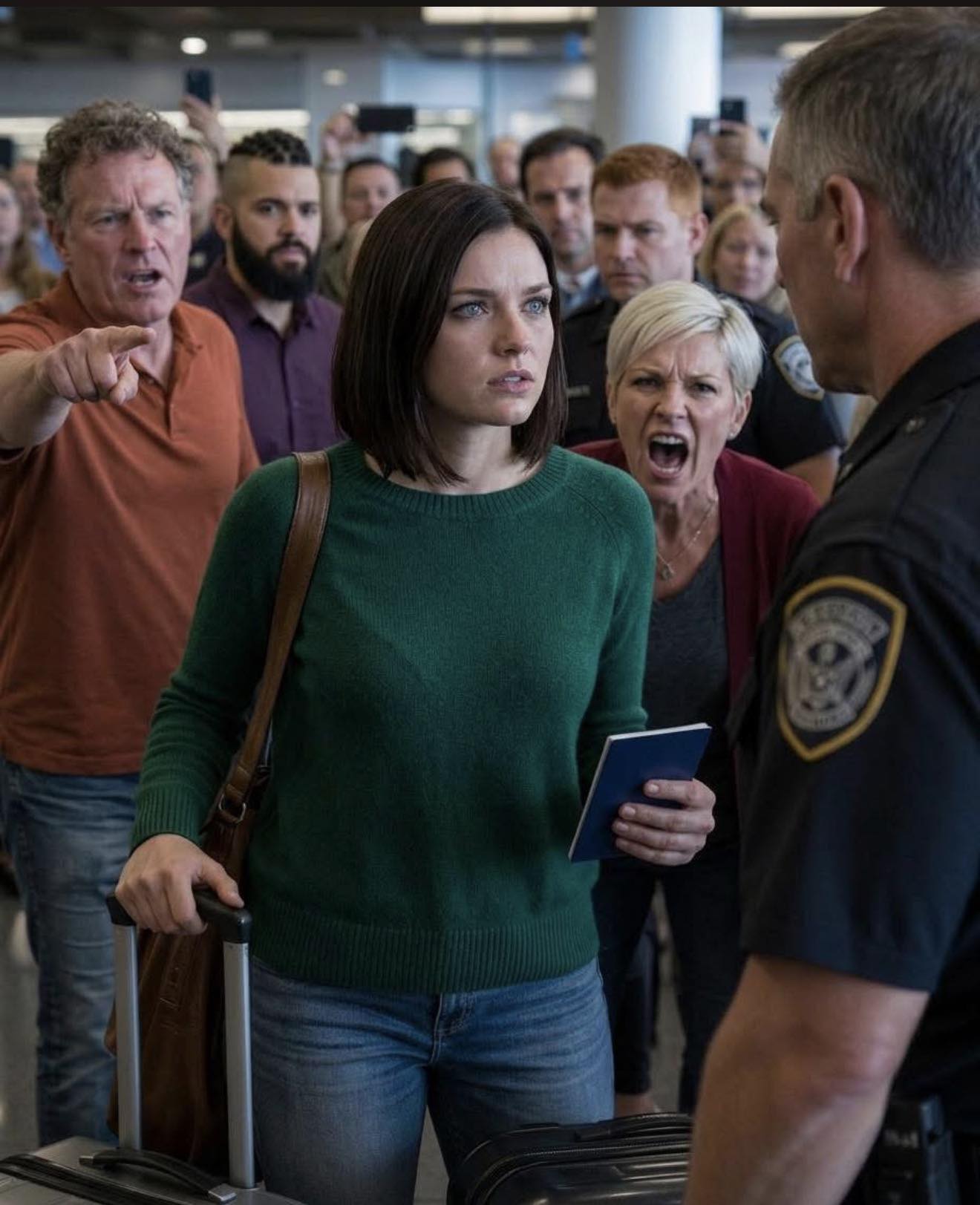
I went through security. I passed the first passport inspection. I was in the international departures line when my mother’s voice echoed through the terminal.
—There it is!
My blood ran cold immediately.
Brenda and Richard were running toward me with two airport police officers behind them. Harper wasn’t there. Perhaps even she had the good sense not to follow them onto federal land.
“He stole from our company!” Richard shouted. “He’s fleeing the country!”
A security guard stepped in front of me.
—Ma’am, please step out of line.
**PART 5 (continued)**
And suddenly I was standing in the middle of the terminal, with my parents yelling, travelers staring, and my flight to Rome counting down the minutes.
Then Officer David Rollins approached us.
And he recognized me.
—
Officer Rollins had met me two years earlier at a Customs and Border Protection commemorative gala in New Orleans.
The original catering company had canceled forty-eight hours before the event. Richard accepted the contract for three hundred guests, promised luxury service, and then deliberately reduced the kitchen staff to increase profits. I ended up cooking almost the entire dinner myself. Braised short ribs. Grit shrimp. Cornbread madeleines. Three different sauces. Two desserts. My hands were so blistered that I wrapped them in towels and kept serving dishes.
At the end of the night, Richard tried to take all the praise.
Officer Rollins walked right past him and shook my hand.
“Miss Cook,” he said then, “walked into a mess and delivered perfection.”
It was the first time a man in power looked at me and saw my work instead of my usefulness.
Now it was standing in front of me in an airport terminal while my parents tried to turn it into a weapon against me.
“Miss Cook,” he repeated. “What exactly is happening here?”
Before he could speak, Brenda rushed towards him.
—Officer, thank God. She’s unstable. She stole funds from the business. She emptied our accounts. We’re terrified she’s having some kind of breakdown.
Richard pointed aggressively at my suitcase.
—He’s trying to escape.
Rollins didn’t flinch.
“And you are…?”
—Your father.
“Her mother,” Brenda added quickly, her eyes immediately turning to tears. “We were just trying to protect her.”
A laugh escaped me before I could stop it. Small. Cold.
Rollins turned to me.
“Do you have ID?”
I handed him my new passport along with my driver’s license. His eyes lingered for a moment on the passport.
“There was a previous alert for a stolen passport associated with your name,” he said carefully.
“Yes,” I replied. “Because my mother impersonated me and reported it stolen after taking it from my safe deposit box.”
Brenda gasped dramatically.
—That’s a lie.
I pulled a small flash drive from my purse.
“Here’s the affidavit, the attorney’s records, the forged business documents, the IRS notice, and the extortion contract he tried to force me to sign.”
Rollins held my gaze.
“Extortion contract?”
I unfolded the yellow legal paper and handed it to him.
Brenda’s face lost all color.
“This is my mother’s handwriting,” I explained. “She demanded I sign over all my savings to cover Cook Catering and Harper’s baby shower. When I refused, they locked me in a storage room above the kitchen.”
“My God…” someone whispered in the crowd.
Brenda intensified her crying.
—It’s not right. It distorts everything. She’s always been dramatic.
Rollins read the contract slowly. Then he looked at Richard.
—Sir, you reported that your daughter stole from the business.
—Yes —Richard blurted out.
“Interesting,” Rollins replied. “Because according to the preliminary documents, she appears to be the sole registered owner of that company.”
Richard opened his mouth.
Nothing came out.
I watched as her confidence crumbled on her face in real time.
Rollins continued in a calm voice that somehow sounded dangerous.
—You requested police intervention at an international airport based on a theft report related to a company that legally appears to belong to her. Furthermore, you reported a flight risk linked to a passport that may have been fraudulent. Do you understand the seriousness of this?
Brenda stopped crying.
Rollins turned to the airport agents.
—Separate them.
Two officers immediately approached my parents.
**PART 5 (continued)**
Richard made one last attempt.
—This is a family matter.
“No,” Rollins said firmly. “This is possible false accusation, identity theft, extortion, corporate fraud, and misuse of federal security procedures. These are not family matters.”
The word *federal* changed the atmosphere instantly.
Brenda’s knees buckled. Richard’s face turned gray.
Travelers everywhere already had their phones raised. Recording. Whispering. Watching the Cook family unravel under the airport’s fluorescent lights.
Rollins looked at me again. His expression softened slightly.
—Miss Cook, you have the right to file formal charges immediately. We can begin the process now.
For a second, I looked at my parents.
I expected rage. Satisfaction. Some kind of vengeful explosion in my chest.
But I didn’t feel anything.
They had already stolen years from me. They took away my sleep, my money, my job, my vacations, my birthdays, and the version of me that once begged for their love. If I stayed in that terminal doing paperwork, they would steal another afternoon from me.
I shook my head.
—They’re not worth missing my flight.
Brenda shuddered.
Richard looked at me as if he no longer recognized me.
Rollins nodded once.
—Understood. We will keep copies of the evidence and proceed with the questioning based on the false report filed today. You may contact her later.
—Thank you— I said.
As the airport police were taking my parents away, Brenda turned to me.
“Farrah,” he pleaded, suddenly soft. “Honey, please. Don’t do this to your family.”
There it was.
*Dear.*
The word I kept for emergencies. The word I used when orders stopped working. The word that would have broken me inside before.
I looked at the handcuffs on her wrists.
“You did this to your family,” I said quietly. “I’m just leaving.”
Then I turned around.
My door was already boarding.
I walked towards her with my passport in my hand and didn’t look back.
—
**PART 6**
The flight to Frankfurt took off at 1:07 pm
I watched Louisiana disappear beneath the plane until the swamps, roads, and neighborhoods became green and brown smudges under layers of white clouds. Somewhere below, Harper’s baby shower was falling apart. Somewhere below, my parents were trying to explain themselves to federal agents. Somewhere below, Cook Catering was going under thanks to my credit.
During the first hour, I didn’t cry.
I sat perfectly still, my hands clasped in my lap, waiting for panic to strike. I’d lived so many years under pressure that peace seemed suspicious. Every time a flight attendant walked by, my heart raced. Every time the seatbelt sign sounded, I expected someone to call my name and drag me back.
But nobody came.
Nobody came.
Någonstans över Atlanten, efter att kabinljusen dämpats och främlingarna runt mig somnat, kom tårarna till slut. Tyst. Inte våldsamt gråtande. Inte den sortens skådespel som Brenda brukade spela upp för publik. Bara en stilla, jämn sorg över flickan som i åratal förväxlade att vara användbar med att vara älskad.
Jag grät för varje middag jag missade för att Richard hade bokat för många evenemang.
Jag grät för varje gång Harper kallade mig självisk medan hon bar kläder köpta med pengar jag hade tjänat.
Jag grät för varje födelsedagstårta jag bakade åt alla andra medan ingen kom ihåg min.
Sedan somnade jag.
När jag vaknade gick solen upp över Europa.
Rom doftade av espresso, regn, gammal sten och möjligheter.
Två dagar senare skakade min kursledare i det kulinariska programet min hand som om jag verkligen hörde hemma där. Min lägenhet var liten, med en smal balkong mot en gata där vespor surrade förbi som irriterade insekter. Jag köpte tomator, basilika, ägg och färskt bröd på en marknad där ingen kände mitt efternamn. Den första kvällen lagade jag middag åt mig själv och åt långsamt vid ett litet träbord.
Ingen krävde en tallrik.
Ingen frågade varför såsen var sen.
Ingen kallade mig otacksam.
Veckor gick. Sedan månader.
Marcus Vance handled the legal meltdown in Louisiana. Valerie only forwarded updates when necessary. My parents were investigated for identity theft, forged business documents, tax fraud, and filing a false report at an international airport. Brenda’s country club friends disappeared. Richard’s clients vanished. Harper’s wealthy family quietly postponed all public events “until things calmed down.”
Things never calmed down.
They surfaced.
The fraudulent transfer of the company was reversed. My personal liability was questioned and separated from the fraudulent records. The IRS investigation was expanded to include Richard and Brenda. The Cook Catering team was liquidated. The house was put up for sale.
Harper once sent me an email.
The message read: “You ruined everything.”
I deleted it without opening it.
A year later, I was in a training kitchen in Rome watching American tourists sample a dish I had created: Gulf shrimp with saffron risotto and pickled celery leaf. It was a bridge between where I had come from and where I had decided to be.
After the service, my instructor called me aside.
“There’s a group of restaurants in Chicago asking about you,” he told me. “They want someone who understands Southern American cuisine and European operations.”
I laughed softly.
For the first time, the United States sounded like a place I could return to on my own terms.
Two years after the airport incident, I opened a small restaurant in Charleston. Not huge. Not flashy. Just mine. I called it **Second Passport**.
On opening night, Valerie was at the best table in the restaurant. Officer Rollins was also there, off duty, with his wife. When I saw him, I came out of the kitchen and shook his hand.
“You made your flight,” he said.
-I did it.
—And the food?
I smiled.
—Better than the memorial dinner.
Serious.
—That’s a high standard.
Near closing time, I stepped out into the warm Carolina night. Behind me, the restaurant windows shimmered with golden light. Inside, people were eating food I had created because they wanted to, not because someone forced me to.
My phone vibrated.
A message from an unknown number in Louisiana.
“Your mother is sick. She wants to hear your voice.”
I stared at the screen for a long moment.
Then I wrote a single sentence.
“I hope she receives the care she needs.”
After that, I blocked the number.
Some people would call it cruelty.
I call it precision.
Family isn’t a life sentence. Blood isn’t a binding contract. Love doesn’t require you to give up your passport, your savings, your job, your future, or your name.
My parents tried to stop me from leaving the country.
A customs agent recognized me anyway.
But the truth is that I recognized myself first.
And once I did it, no one could erase me again.